

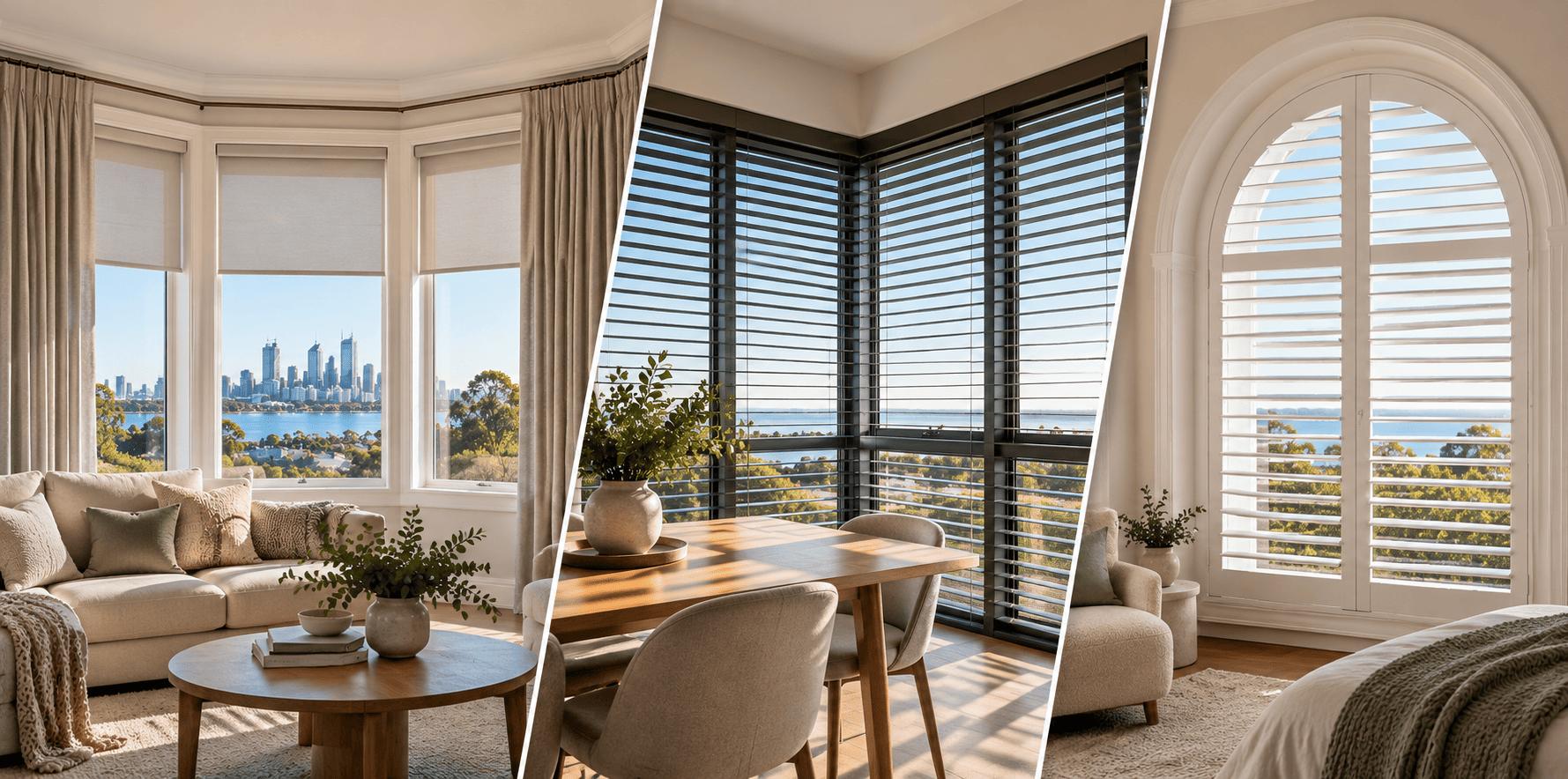
A beautiful bay window can become awkward where two blinds meet. Corner windows leave little room for brackets, while arched windows rarely accommodate standard rectangular fittings.
The challenge isn’t simply choosing between curtains, blinds and shutters. It’s finding a covering that follows the window’s shape, controls light, preserves the view and operates without obstruction. For Perth homeowners, this guide explores practical fitting solutions for bay, corner and arched windows, including where custom tracks, individually fitted blinds or shaped shutters make the difference.
First, Identify the Window Shape You're Working With
Before choosing curtains, blinds or shutters, examine how the window sections meet. Their shape determines where tracks, brackets and frames can be installed and how easily the coverings operate.
Bay and Bow Windows
Bay windows project outward through angled glass sections, while bow windows use several sections to create a gentler curve. Bay window curtains may require angled or curved tracks, whereas bay window blinds and shutters are typically fitted to individual sections. Careful planning prevents neighbouring fittings from interfering with one another.
Corner Windows
Corner windows bring two glazed sections together, either around a structural corner post or through uninterrupted glass. A corner post may provide fixing options, while frameless corners require more careful mounting arrangements. Corner window curtains also need sufficient stacking space and carefully planned track junctions.
Arched Windows
Arched windows include rectangular openings with curved tops, full arches and semicircular designs. The curve determines whether coverings can sit above the entire opening, below the arch or require custom-shaped fittings.
Bay Windows: Should You Choose Curtains, Blinds or Shutters?
Bay windows can accommodate curtains, individually fitted blinds or custom shutters. The right choice depends on the angles between window sections, available fixing space and whether you prefer independent light control or a continuous covering across the entire bay.
Bay Window Curtains - Following the Angles Without Losing the View
Bay window curtains work particularly well when you want to soften the window’s angular shape without concealing its architectural character.
A custom-bent or angled curtain track can follow the bay’s contours, provided the track system supports the required bends and curtain weight.
There are two main arrangements to consider:
- Continuous curtains: A suitable track runs around the bay, allowing the fabric to move across multiple window sections for a unified appearance.
- Separate curtain panels: Individual sections offer more flexibility when adjusting privacy and daylight across different panes.
Stacking space matters. This is where curtains gather when opened. Without sufficient space at the ends of the track, the fabric may cover the side windows and reduce the available view.
For living-room bays, floor-length sheers soften incoming daylight while preserving an open feel. Lined curtains offer greater privacy and light control when needed.
Marvel Blinds offers custom curtains in Perth, with tailored fabrics and track solutions. The window angles and available mounting space should be assessed before selecting the final arrangement.
Bay Window Blinds - Why Individual Panels Often Work Better
Unlike straight windows, bay windows have angled sections that make a single blind difficult to fit and operate. Bay window blinds therefore work best as individually fitted units, allowing each section to function independently.
Two practical options include:
- Roller blinds: Provide a clean, minimal finish. However, brackets and roller mechanisms need sufficient clearance where adjoining windows meet.
- Slim-profile Venetian blinds: Suit bays with adequate mounting depth, offering adjustable light and privacy through tilting slats without raising the entire blind.
Watch for corner gaps. Roller blind fabric is narrower than its overall mechanism, potentially leaving small light gaps between angled sections. Poorly positioned brackets may also collide and obstruct operation.
Independent controls are particularly useful in Perth homes, where sunlight can strike different sides of a bay throughout the day. You can shade the sun-facing section while keeping the remaining windows open to daylight.
Shutters for Bay Windows - A Fitted Architectural Finish
Shutters for bay windows offer a clean, built-in appearance by following the window’s individual angles rather than covering the entire opening with one continuous treatment.
Each glazed section typically receives a custom-measured shutter frame, with angled joins carefully positioned to create a cohesive finish. Coordinating louvre sizes and alignment across adjoining panels helps maintain visual consistency.
However, the fitting requires more than accurate measurements:
- Hinge clearance: Panels must open without colliding at angled corners.
- Window access: Frames and louvres should not obstruct handles, locks or opening sashes.
- Light control: Tilting the louvres adjusts daylight and privacy, while opening the hinged panels provides fuller access to the glass.
Not every bay configuration accommodates the same shutter arrangement. Reveal depth, window angles, and panel dimensions determine feasibility. Explore Marvel Blinds’ custom indoor shutters for Perth homes.
Corner Windows: How Do You Cover Glass That Meets at an Angle?
Two individually measured window coverings can still clash where corner windows meet. The challenge is managing the junction without compromising light control or operation.
Corner Window Curtains – One Continuous Look or Two Separate Runs?
Corner window curtains can use ceiling-mounted tracks with compatible corner connectors for continuous movement. Where this isn’t practical, separate tracks offer independent operation. Allow space for curtain returns, stacked fabric and window handles. Even continuous arrangements need careful planning to minimise gaps at the corner.
Roller and Venetian Blinds – Managing the Corner Gap
Roller mechanisms and brackets require clearance where windows meet. Installers must decide which blind extends towards the corner and which terminates alongside it. Small light gaps may remain, particularly with recessed blinds. Independently operated Venetians offer adjustable privacy without raising the entire covering.
What About Frameless Corner Windows?
Uninterrupted corner glazing requires suitable ceiling or adjacent wall fixings. Never assume hardware can attach directly to glass. Resolve corner clearances before choosing fabric or colour.
Arched Windows: Should You Cover the Curve or Leave It Visible?
Arched windows can accommodate conventional curtains, blinds or specially shaped coverings. The main decision is whether to conceal the entire opening or preserve the architectural curve. Your choice affects privacy, light control and how prominently the arch features in the room.
Curtains for Arched Windows – Frame the Shape or Conceal It?
Curtains offer two practical mounting approaches, depending on the window’s configuration.
- Above-arch mounting: Install a straight curtain track above the highest point of the arch, where sufficient fixing space exists. The curtains cover the entire window when closed, providing more complete privacy and light control.
- Below-arch mounting: Position the track beneath the curve, across the rectangular window section. This keeps the arch permanently visible but leaves its upper glazing uncovered.
For bedrooms requiring greater darkness, above-arch mounting is generally more practical. Below-arch curtains suit living spaces where preserving the curved architectural detail takes priority.
The key: Decide how much glass needs covering before selecting the curtain track.
Can You Install Blinds on Arched Windows?
Yes, but standard roller blinds cannot follow the curved upper edge of arched windows. Their straight headrails and rectangular fabric require horizontal mounting.
Two practical installation options include:
- Above-arch mounting: Position the blind above the highest point of the arch, allowing it to cover the entire window when lowered. This requires sufficient wall space and secure fixing points.
- Below-arch mounting: Fit the blind across the rectangular section beneath the curve. This preserves the arch’s architectural detail but leaves the upper glass exposed.
Privacy matters. An uncovered arch can allow unwanted daylight into bedrooms, even when the lower blind uses blockout fabric.
Before installation, assess the arch’s dimensions, mounting depth, and surrounding clearance. A custom measurement helps determine whether the blind can operate smoothly without obstructing the window.
Are Custom-Shaped Shutters Suitable for Arches?
Yes, arched windows can accommodate specially manufactured plantation shutters that follow the curve rather than conceal it. However, the frame and panel configuration must match the window’s exact dimensions.
Common arrangements include:
- Fixed arched section: A custom-shaped upper frame with fixed or fan-shaped louvres that follow the curve.
- Operable lower panels: Hinged rectangular shutters beneath the arch, allowing access to the window and adjustable light control.
Unlike standard rectangular shutters, curved sections may have limited or no opening functionality.
A decorative arch above fixed glazing also requires different planning from an operable arched window, where hinges, handles, and opening clearance must remain accessible. Before selecting shutters, confirm shaped-frame availability, mounting depth and operational requirements with Marvel Blinds. Not every standard shutter system can be adapted to an arch.
Five Things to Check Before Measuring an Unusual Window
Even a small measurement error can cause blinds to overlap, curtains to bunch, or shutter panels to collide. For bay, corner, and arched windows, accurate measurements are essential.
What Should Your Installer Measure?
- Window dimensions and angles: Measure each section’s width, drop, and the angles where adjoining panes meet.
- Reveal and fixing depth: Check available space for brackets, curtain tracks and shutter frames.
- Hardware clearance: Identify handles, locks, flyscreens and opening sashes that could obstruct fittings.
- Operating space: Allow sufficient room for curtains to stack, blinds to operate and shutters to swing open.
- Light-gap risks: Identify angled junctions and curved sections where coverings may leave exposed glass.
Homeowners can provide approximate dimensions and photographs for initial planning. However, complex windows require professional measurements before manufacturing. For mounting considerations, see our guide to recess versus face fitting.
Which Window Covering Suits Each Window Shape?
The right window covering depends on the opening’s geometry, available mounting space, and how much light control you need.
Window shape | Recommended coverings | Key fitting consideration |
Angled bay | Bay window curtains, individual blinds, shutters | Angled joins and stacking space |
Curved bow | Curved-track curtains, custom shutters | Track radius and panel alignment |
Corner | Corner window curtains, roller or Venetian blinds | Bracket clearance and light gaps |
Arched | Above-arch curtains, blinds, shaped shutters | Preserving or covering the arch |
These are starting points, not guaranteed fitting solutions. Actual suitability depends on window dimensions, fixing surfaces and operating clearances, which should be assessed before manufacture.
The Right Fit Starts With the Shape of Your Window
Heavy fabrics can improve insulation, but thickness alone doesn’t guarantee better performance.
A lighter curtain with suitable thermal lining, proper side returns, and a fitted pelmet may outperform a heavier curtain with large gaps.
When comparing options, examine:
- Lining: Thermal backing or additional insulating layers.
- Fabric: Tightly woven material that limits airflow.
- Fit: Full-window coverage with minimal gaps.
- Installation: Suitable tracks, returns, and pelmets.
For Perth winters, effective insulation depends on the complete curtain system, not fabric weight alone.
Thermal Curtains vs Thermal Blinds - Which Keeps Heat In Better?
The better option depends less on the product label and more on how effectively it limits heat transfer and air circulation around your windows. For Perth homes, properly fitted thermal curtains and thermal blinds can both improve winter comfort, but their designs offer different advantages.
Comparing Window Coverings for Winter Insulation
Window covering | Winter insulation benefits | Main limitation |
Lined thermal curtains | Insulating layers and full-window coverage help retain warmth | Top and side gaps reduce effectiveness |
Blockout roller blinds | Fitted fabric provides an additional barrier against cold glass | Edge gaps allow air circulation |
Double roller blinds | Separate fabrics offer flexible daytime and nighttime coverage | Two layers don’t guarantee twice the insulation |
Honeycomb blinds | Cellular pockets trap air and reduce heat transfer | Performance depends on construction and fit |
Create an additional barrier while controlling light | Frame and louvre gaps can reduce insulation | |
Panel and vertical blinds | Cover large windows and sliding doors | Overlapping panels generally provide less airtight coverage |
Which Should You Choose for Your Perth Home?
For bedrooms, thermal blackout curtains can combine light control with insulation. Well-fitted roller blinds suit compact windows, while curtains or panel blinds offer practical coverage for larger openings.
However, installation matters. Insulated curtains with adequate side returns and a pelmet may reduce heat loss more effectively than heavier curtains fitted with large gaps. Prioritise window coverage, suitable lining and everyday usability before comparing prices.
Why the Way You Fit Thermal Curtains Matters as Much as the Fabric
Even high-quality thermal curtains can underperform when warm room air circulates their edges and cools against the glass. Correct installation helps create a stable insulating air pocket rather than simply covering the window.
Cover the Complete Window, Not Just the Glass
When comparing custom and ready-made curtains, measure beyond the window frame, not just across the glass. Where practical, choose floor-length insulated curtains that extend past both sides of the opening.
Allow enough fabric width for generous overlap when closed. Curtains that stop at the sill or leave exposed edges allow more air circulation, reducing their insulating benefit.
Reduce Heat Loss Around the Top with Pelmets and Suitable Tracks
Warm air can rise behind curtains, cool against the glass and sink back into the room.
A properly fitted pelmet covers the gap above the curtain track, helping limit this circulation. Ceiling-mounted tracks can also reduce exposed space above the curtains when pelmets aren’t suitable.
Choose the Right Curtain Returns and Blind Fit
Curtain returns bring the fabric back towards the wall, reducing gaps at the sides.
For thermal blinds, consider whether recess or face fitting provides better window coverage without interfering with handles or operation.
Before installation, check:
- Track position: Minimise gaps above the curtain.
- Side returns: Extend coverage towards adjoining walls.
- Floor clearance: Keep curtains close to the floor without dragging.
- Window access: Preserve ventilation and normal window operation.
Which Window Coverings Work Best for Different Perth Rooms in Winter?
Different rooms need different combinations of insulation, light control and accessibility. Choosing the right window covering means considering how each space is used throughout the day.
Bedrooms: Warmth, Privacy and Blockout
Bedrooms often feel coldest before sunrise. Floor-length thermal curtains with insulating linings help reduce heat loss through glazing, while thermal blackout curtains also provide darkness for better sleep.
For added flexibility, combine well-fitted blockout roller blinds with lined curtains. This allows independent light control and additional window coverage. For another approach to daytime privacy and filtered light, explore layering sheer curtains with blinds.
Living Rooms: Retain Warmth Without Sacrificing Winter Sunlight
Winter sunshine provides useful natural warmth. Open curtains during sunny hours, then close insulated curtains or thermal blinds as direct sunlight fades to reduce overnight heat loss.
In Perth, north-facing windows generally receive more direct winter sunshine, while south-facing rooms receive less and may benefit from consistent insulating coverage.
Sliding Glass Doors: Coverage Without Blocking Access
Large glass doors expose more glazing, making coverage particularly important.
Full-height thermal curtains can provide generous overlap around door frames, while panel blinds offer convenient sideways operation for frequently used entrances.
However, panel blinds have overlapping sections and edge gaps that allow air circulation. For better winter comfort, prioritise adequate coverage without obstructing door handles, tracks or everyday access.
The Simple Daily Curtain Routine That Helps Keep Your House Warmer
In Perth, winter window coverings work best when adjusted to the sunshine, rather than left closed all day. A few simple habits can help capture natural warmth and reduce heat loss after sunset.
From Morning Sunshine to Evening Insulation
- Open sun-facing coverings: Draw back curtains or raise blinds when direct sunlight reaches your windows.
- Make use of daytime warmth: Let sunlight enter living areas during sunny hours, particularly through north-facing windows.
- Close curtains before temperatures drop: Once direct sunshine disappears, fully close thermal curtains or insulated curtains to limit heat loss through the glass.
- Keep heated spaces contained: Close doors between heated and unheated rooms while maintaining necessary ventilation.
Well-fitted thermal blinds can follow the same routine. Consistent timing and complete window coverage help maximise their insulating benefits.
A Five-Minute Winter Window Check Before Buying New Curtains
Before investing in thermal curtains, check where your room is losing warmth. A few observations can help you avoid unnecessary replacements.
Check for Draughts When Windows Are Shut
On a windy day, hold a tissue near window-frame edges. Movement may indicate air leakage that curtains alone cannot fix.
Examine Your Existing Curtain Coverage
Close your curtains completely. Look for gaps above and beside the fabric, short hems and deteriorating linings. Even insulated curtains lose effectiveness when poorly fitted.
Identify Your Coldest Room
Check where you feel the most discomfort, particularly near large glass windows after sunset. Prioritise these areas before upgrading every window covering.
Know When Curtains Aren’t the Solution
Damaged window seals, persistent condensation, mould or inadequate ceiling insulation require separate attention. Thermal blinds cannot resolve underlying building defects. Never block required ventilation or emergency exits.
Which Window Covering Suits Each Window Shape?
The right window covering depends on the opening’s geometry, available mounting space, and how much light control you need.
Window shape | Recommended coverings | Key fitting consideration |
Angled bay | Bay window curtains, individual blinds, shutters | Angled joins and stacking space |
Curved bow | Curved-track curtains, custom shutters | Track radius and panel alignment |
Corner | Corner window curtains, roller or Venetian blinds | Bracket clearance and light gaps |
Arched | Above-arch curtains, blinds, shaped shutters | Preserving or covering the arch |
These are starting points, not guaranteed fitting solutions. Actual suitability depends on window dimensions, fixing surfaces and operating clearances, which should be assessed before manufacture.
The Right Fit Starts With the Shape of Your Window
Beautiful windows shouldn’t demand compromises. Bay angles need precise alignment, corner junctions require clearance, and arched windows deserve solutions that respect their curves.
Every detail matters. Contact Marvel Blinds for a free measure and custom fitting advice for your Perth home.
Frequently Asked Questions
Individually fitted roller or Venetian blinds are practical options for bay windows. The best choice depends on window angles, mounting depth, bracket clearance and privacy requirements.
Not always. Angled bay windows may use joined tracks, while curved bays may require suitably bent tracks. The system must accommodate the window's angles and curtain movement.
Yes. Custom shutters for bay windows can follow individual window sections. Accurate measurements, angled frame joins and sufficient hinge clearance are essential for proper operation.
Corner window curtains can use compatible corner-track systems or separate tracks. The right arrangement depends on fixing points, curtain stacking space and access to window handles.
Careful measuring and planned bracket positioning can minimise gaps. Overlapping or butting arrangements improve coverage, although adjoining roller blinds may still leave small gaps.
Conventional blinds can be mounted above the entire arch or below its curved section. Standard roller blinds cannot independently follow the curved upper edge.
Yes. Specially shaped shutters can follow curved openings, sometimes combining a fixed upper section with operable lower panels. Availability depends on the shutter system and window dimensions.
Cover the entire opening when privacy or room darkening takes priority. Leaving the arch exposed preserves its architectural character but allows daylight through the uncovered upper glazing.