

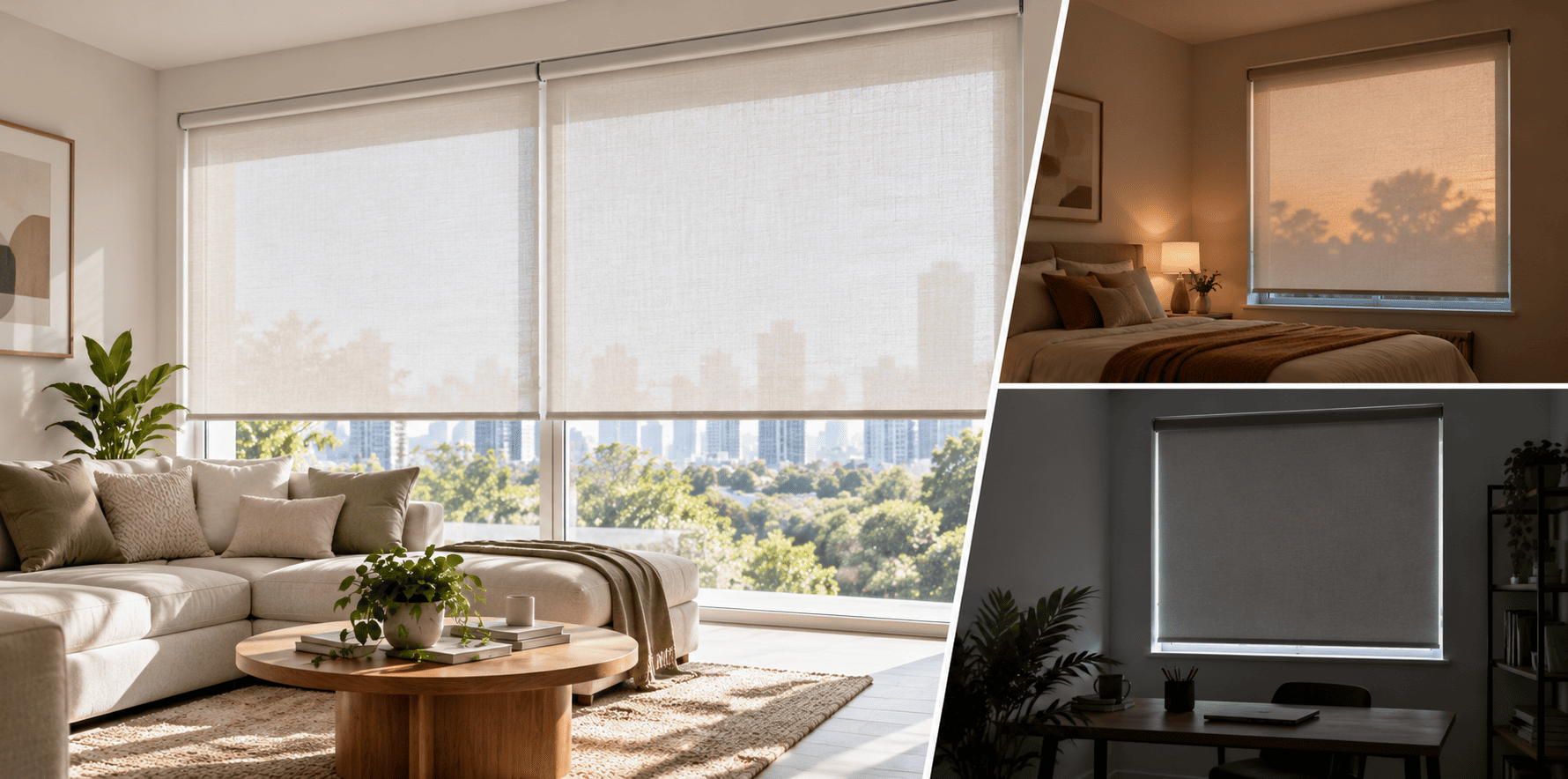
Light filtering roller blinds are one of the most common choices for homes because they solve an everyday problem well: they soften harsh daylight without shutting it out. But the same fabric that makes a living room feel calm and bright can leave a west-facing bedroom stuffy, or start looking tired in a steamy ensuite within a few years. Whether they work comes down to what each room actually has to deal with: heat, moisture, glare, and how much darkness it needs.
What light filtering roller blinds do differently from sunscreen and blockout
Light filtering fabric is translucent. It lets daylight through but scatters it as it passes, so the room is lit evenly, without sharp beams of sun, bright patches on the floor, or glare bouncing off screens and glossy surfaces.
That sets it apart from the other two main roller blind fabrics. Sunscreen fabric is an open-weave mesh. It cuts glare and some heat while keeping a view outside during the day, but because it has small openings, some direct light still comes through. Blockout fabric uses an opaque coating or layered construction so light doesn’t pass through the fabric itself. Light filtering sits between the two. You won’t get a clear view out, only light and soft shapes, but the light inside is gentler than with sunscreen, and there’s far more of it than with blockout.
Fabric colour changes the result too. Fabric colour changes the result too, and the blind fabric guide explains how material, construction and durability affect performance. White and ivory fabrics glow brightly and keep a room feeling open. Darker shades mute the light more, but they can make the space feel dimmer and tend to absorb more heat.
Light filtering roller blinds are designed to turn bright, direct light into comfortable daylight. They aren’t designed to control heat or create darkness, and most standard fabrics aren’t made for constant damp. Those three limits explain almost every case where they disappoint.
Living areas, home offices and south-facing rooms: where soft daylight is the goal
These blinds perform best in rooms that are used mainly during the day and where the aim is comfortable brightness rather than protection from something harsher.
Living and dining rooms are the clearest fit. They’re used through the day, they often have TVs or polished surfaces that pick up glare, and they benefit from staying bright even with the blinds down. A light filtering blind can stay lowered for most of the day without the room feeling closed in. It also cuts the direct sun falling on floors and furniture, although no standard fabric is a complete UV barrier.
Home offices suit light filtering well because diffused light reduces reflections on screens. Desk position matters, though. If your monitor sits in front of a window that takes strong afternoon sun, the fabric will glow brightly behind the screen and can still be tiring to look at. Moving the desk side-on to the window, or choosing a slightly denser light filtering fabric, usually helps more than switching to blockout and working in a dim room.
South-facing rooms in Perth get mostly indirect light throughout the day and rarely deal with direct sun, so heat is seldom the issue. Here, light filtering keeps the room bright and even, while a blockout fabric can make an already softly lit room feel gloomy.
North-facing rooms with reasonable eaves can also work well. The high summer sun is largely shaded by the eaves, while the lower winter sun reaches further into the room. A light filtering blind lets that winter light and warmth through while taking the edge off the glare.
East-facing rooms are more situational. Morning sun is strong but arrives early, so light filtering suits kitchens, family rooms and breakfast areas where you’re up and about by then. It suits bedrooms far less if you’d like to sleep past sunrise.
Why light filtering struggles with heat in Perth's west-facing rooms
West-facing rooms are where light filtering roller blinds most often let people down, and in Perth the reason is easy to see. Afternoon sun comes in at a low angle that eaves can’t block, and it arrives at the hottest part of the day.
The problem is where the blind sits, because understanding solar heat gain is important when comparing how different window coverings perform. An internal blind is on the inside of the glass, so by the time the sun reaches the fabric, much of the heat has already passed through the window. The fabric diffuses the light well, but it also absorbs some of that energy and releases it back into the room. You end up with a bright, glowing blind, a warm room, and an air conditioner working harder than expected. The same happens in sunrooms, enclosed patios, and rooms with large areas of glass that take sun for most of the day.
Several options handle heat better, and each gives something up:
- Denser sunscreen fabrics keep a daytime view and handle glare well, but they still let some direct light through and suit rooms where you don’t need privacy or darkness.
- Blockout fabrics with a light-coloured or reflective backing facing the glass can reflect more of the sun back out, but the room becomes dark while the blind is down, which is awkward in a living space during the day.
- Dual roller blinds pair a light filtering or sunscreen fabric with a blockout, letting you switch between soft light and heat control as the afternoon wears on. They cost more and need more mounting depth.
- External shading, such as awnings or outdoor blinds, stops the sun before it reaches the glass. It is generally the most effective way to reduce heat gain, but it’s a bigger investment and involves exterior mounting and exposure to the weather.
Strong, sustained sun can also fade or weaken some fabrics sooner, so it’s worth asking how well a fabric resists UV before putting it on a west-facing window. For a closer look at how orientation and fabric choice affect indoor temperature, see why some rooms feel hotter than others and how roller blinds Perth homeowners choose can reduce heat gain.
How humidity in bathrooms, ensuites and laundries affects fabric and mechanisms
Bathrooms, ensuites and laundries expose a blind to something most light filtering fabrics aren’t built for: repeated cycles of humidity and drying.
Condensation forms on the glass after a shower and runs down to the bottom of the blind, which is usually where problems start. Over time, standard fabric can develop mould or mildew spots along the lower edge, stains that don’t clean out, and edges that curl or ripple as the material absorbs moisture and dries again. The mechanism can suffer too. Metal chains, brackets, and internal components may corrode, and a blind that once rolled smoothly can start to catch or sit unevenly.
Ventilation makes a big difference. A large bathroom with an exhaust fan and a window that’s opened regularly is a very different environment from a small ensuite that stays damp for hours after every shower. The less the room airs out, the faster standard fabric tends to deteriorate.
Not every light filtering fabric behaves the same way. Some are PVC-coated, fibreglass-based or treated for wet areas and cope with humidity much better. If you want a roller blind in a bathroom, ask specifically whether the fabric is suitable for wet areas and whether the components resist corrosion, rather than assuming any light filtering option will do. In very damp rooms, moisture-resistant alternatives such as PVC or aluminium venetians may be worth comparing.
Laundries vary. Some are dry, while others deal with dryer heat, indoor drying and poor airflow, and those need the same care as a bathroom. Kitchens bring steam and grease near the cooktop, which is covered in more detail in best kitchen window treatments.
Why nurseries, media rooms and some bedrooms need real darkness
Some rooms don’t have a heat or moisture problem. They need darkness, and softened light isn’t enough.
Nurseries are the most common example. Daytime naps and early summer sunrises both call for a genuinely dark room, and a light-filtering blind leaves a nursery noticeably bright, which can make settling harder. Blockout is the usual starting point, but a roller blind still lets light leak around its sides, so how it’s fitted matters. Mounting outside the recess with a generous overlap, or adding side channels, reduces those gaps. A dual roller gives you blockout for sleep and light filtering for playtime.
Media rooms need control over light, not just glare reduction. Light filtering stops sun hitting the screen directly, but the glowing fabric still lifts the overall brightness of the room, which washes out contrast on a TV and especially on a projector.
Bedrooms depend on the person sleeping in them. Some people like waking gradually with the light, and a light filtering blind suits them well. Shift workers, light sleepers and anyone in an east-facing bedroom will usually be happier with blockout or a dual roller. Night-time privacy is a separate question, covered in can people see through light filtering roller blinds at night?
Checklist: is your room a good fit for light filtering roller blinds?
A few quick questions will usually show whether light filtering roller blinds suit a room or whether one factor needs solving first:
- Which way does the window face? South-facing rooms and north-facing rooms with good eaves are generally a strong fit. West-facing windows raise the heat question. East-facing windows raise the early-morning light question in bedrooms.
- Does direct sun hit the window during the hours the room is used? A room that takes afternoon sun while you’re in it has different needs from one that only gets sun while it’s empty.
- Is there regular steam or condensation? Mould on the sill, grout, or window frame is a good sign that standard fabric will struggle.
- How well does the room ventilate? An exhaust fan or a window you actually open makes a real difference.
- Does the room ever need to be dark? Daytime naps, shift work, early sunrises, or a projector all point beyond light filtering.
- Is glare on screens a concern? Light filtering handles this well, but desk and TV placement still matter.
- Do you want to see outside during the day? If a view matters, sunscreen fabric may suit better.
If you can, ask for fabric samples and hold them against the window at the time of day that matters most, such as mid-afternoon for a west-facing room or early morning for a bedroom. A sample seen in the real light of that room will tell you more than any showroom display.
If most of your answers point to a room that wants soft daylight and stays reasonably dry, light filtering is likely to work well. If one factor clearly dominates, whether that’s heat, humidity or the need for darkness, it’s usually better to choose for that first and treat soft light as a bonus.
Frequently Asked Questions
Living rooms, dining areas, home offices and other daytime spaces are generally the best fit when the goal is to soften sunlight without making the room dark. They work particularly well in rooms that need comfortable daylight but don't face severe afternoon heat or persistent moisture.
They can be, especially in bedrooms where you like natural morning light and don't need complete darkness. They are less suitable for east-facing bedrooms, shift workers, light sleepers or anyone who needs the room dark for daytime sleep. In those situations, blockout or a dual roller is usually the better fit.
Yes, but it depends on what you want the blind to achieve. They are good at diffusing strong daylight and reducing glare, but they are not a strong heat-control solution. A heavily sun-exposed west-facing room can remain hot even with the blind fully lowered.
They can work very well on north-facing windows when the window has reasonable eaves or other shading. The blind can soften the daylight while still allowing winter sun into the room. If the window receives prolonged direct summer sun, however, heat control needs to be considered separately.
Only if the fabric and components are designed for the environment. Standard light filtering fabrics can struggle with repeated condensation and humidity, particularly in poorly ventilated bathrooms. For wet areas, check that the fabric is moisture-resistant and that the blind's hardware is suitable for humid conditions.
They can reduce harsh direct glare by diffusing incoming sunlight, but they don't eliminate brightness altogether. If the window is directly behind a monitor or opposite a TV, the glowing fabric can still create reflections or reduce screen contrast. Window orientation and screen placement matter as much as the fabric.
They can soften the intense afternoon light, but they are usually not the best choice when the main problem is heat. West-facing windows receive low-angle afternoon sun that can pass through the glass before reaching the internal blind. For these rooms, consider a sunscreen, reflective blockout, dual roller or external shading depending on whether heat, view or daylight matters most.
No. Their purpose is almost the opposite: they diffuse sunlight while keeping the room naturally lit. The exact brightness depends on the fabric's openness, colour and density, but they should not be expected to create the darkness provided by blockout fabric.