

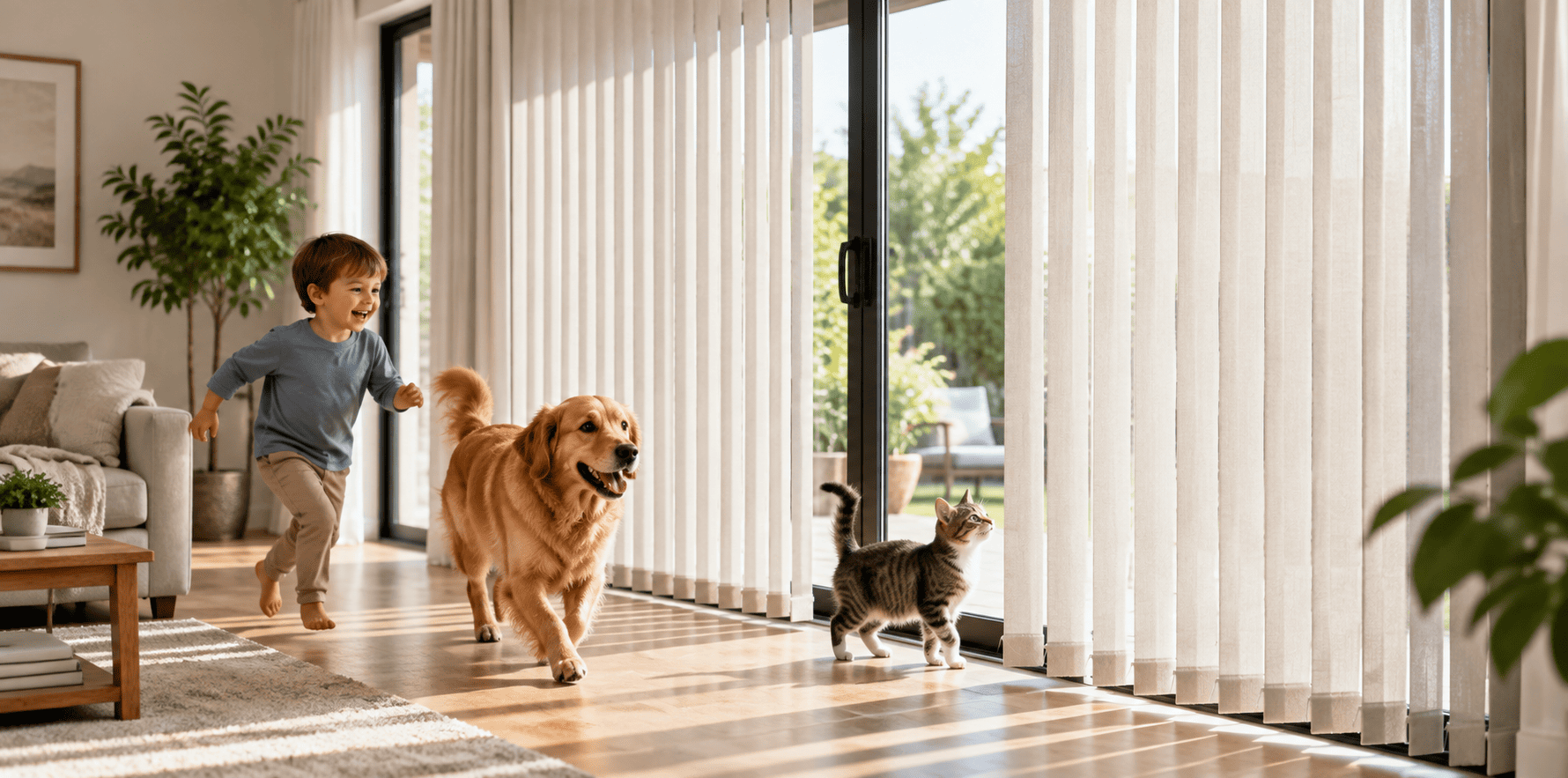
A sliding door is one of the hardest places in the home for a blind person to live. Unlike a bedroom window that might be opened once or twice a day, a sliding door can be used dozens of times. People walk through it, kids grab the blind on their way outside, dogs push through the opening and dirt from outdoors eventually finds its way into the track.
So if you’re choosing blinds for sliding doors, durability is worth thinking about before installation. The important question isn’t simply which blind looks sturdy. It’s which parts are most likely to take a beating in your home, and what can you do about it?
What Usually Fails First on Sliding Door Blinds?
The problem is a combination of traffic and repetition. The blind sits beside an opening that people use constantly, so it is exposed to more accidental contact than a blind on a normal window. It is also being moved repeatedly, often quickly, because nobody wants to spend time carefully operating a blind when they are carrying groceries, letting the dog out, or trying to get the kids into the backyard.
That creates two types of wear: mechanical wear from repeated operation and physical wear from people and pets hitting the blind itself.
Once you understand those sliding-door requirements, it becomes much easier to see which components deserve the most attention.
Tracks and Moving Parts Take the Most Wear
If we had to put the failure points in order, the track and its moving components would be near the top of the list simply because they deal with repeated movement every time the blind is opened, closed, or stacked.
Dust, pet hair, and grit can build up around the track and make movement less smooth. Pulling harder when the blind starts resisting only adds more strain.
Watch for early warning signs:
- The blind no longer glides as smoothly.
- Sections do not stack evenly.
- The blind feels unusually stiff or catches during movement.
- You need noticeably more force to operate it.
These symptoms do not necessarily mean the track has failed. They can indicate that cleaning, adjustment, or servicing is needed before a small problem becomes a damaged component.
For a busy family, this is an important distinction: smooth operation is often a better indicator of long-term durability than how heavy or solid the blind feels in the showroom.
Louvres Take the Most Physical Damage
The second major wear point is the part everyone can physically reach. Vertical louvres can be pushed aside by a dog’s nose, caught by paws, or grabbed by children. Individual louvres can bend or become misaligned when they are repeatedly forced in the wrong direction.
This is where vertical blinds have a practical advantage for many wide sliding openings: individual louvres can move independently, so damage to one section does not automatically mean replacing the entire blind. Marvel Blinds notes that you can replace individual vertical blind slats if they’re damaged.
The bigger issue is repeated rough handling. A louvre that gets pushed aside occasionally is one thing. A dog that uses the blind as the fastest route to the backyard every day is another.
Wands and Chains Can Fail Under Force
Operating components tend to suffer from a different kind of abuse. A wand or chain is designed to operate the blind, not to act as a handle for pulling the entire system sideways or something for a child to swing from. When someone uses excessive force, twists the mechanism, or pulls against resistance, the operating component can become the point of failure.
The useful rule is simple: if the blind stops moving normally, don’t compensate by pulling harder.
Something may be caught, misaligned, or obstructed. Finding the cause is usually preferable to turning a minor operating issue into a broken component.
Uneven Stacking Is Often an Early Warning Sign
A blind that no longer stacks neatly can look like a major mechanical problem, but uneven stacking is often the result of another issue – a bent louvre, a carrier that is not moving correctly, debris in the track, or a component that has shifted. This is why it is worth paying attention to changes rather than waiting for something to break completely.
If your sliding door blinds suddenly bunch up differently, leave sections behind, or require more effort to move, investigate early. Small alignment problems are generally easier to deal with than a system that has been repeatedly forced while operating poorly.
How Pets Can Wear Down Sliding Door Blinds
Pets tend to cause repeated low-level physical damage. A dog may push its nose or paws through the louvres every time the door opens. A cat may scratch at the lower section or investigate moving fabric. Over time, that contact can bend sections, mark surfaces, and disturb alignment.
Then there is the less obvious culprit: hair and dirt. Pet hair can accumulate around tracks and moving components, particularly near a door leading directly outdoors. Regularly removing this debris is one of the simplest things you can do to keep the mechanism moving properly, and cleaning blinds correctly can help prevent unnecessary wear.
If your pet routinely uses the sliding door, look at the bottom section of the blind first. That is where everyday contact tends to happen.
How Kids Can Damage Blinds for Sliding Doors
Children are more likely to cause short, sharp bursts of force. They may grab the wand, pull the blind sideways, hold onto the bottom rail, or move the blind without checking whether it has reached the end of its travel. Another common problem is the sliding door itself being moved into a blind that has not been stacked fully clear.
You don’t need to turn the blind into a restricted area. The more useful approach is to make sure the operating system suits a high-traffic doorway and that everyone knows the blind needs to move freely rather than be forced.
Which Blinds for Sliding Doors Handle Daily Family Uses Best?
This is where durability becomes more useful than simply asking which style looks good.
Vertical blinds are naturally suited to wide sliding openings because the louvres move sideways and stack away from the doorway. Their individual sections also mean one damaged louvre does not necessarily compromise the whole blind.
Panel blinds use larger fabric panels that glide along a track. There are fewer individual sections to bend, but the larger panels can show damage more clearly if they are repeatedly caught or pulled.
Roller blinds have fewer exposed sections, so there is less for a child or pet to push between. However, they operate by rolling up and down rather than moving sideways. That makes the actual door configuration and frequency of operation important when considering them for a busy opening.
So the durability question isn’t simply “Which style lasts longest?” It’s which design has the fewest opportunities to be damaged by the way your household uses the door? The material matters too, particularly when the blind is exposed to daily handling, sunlight, and dust.
Things to check:
- How often the door is used
- Whether children or pets push through the opening
- Where the blind stacks
- Whether the stack interferes with the door
- How easy the track is to clean
- Whether individual components can be replaced
- How the blind is operated
- Whether the system is designed for frequent movement
How to Make Sliding Door Blinds Last Longer
You cannot stop children and pets from using the room, and you shouldn’t have to. The goal is to remove the avoidable stress.
- Move the blind clear before opening the door if the stacked blind could interfere with the door.
- Operate the blind using its intended mechanism, rather than pulling on individual louvres or panels.
- Keep the track free from pet hair, dust and grit.
- Clean the lower sections regularly, particularly if pets push against them.
- Never force a blind that suddenly feels stuck.
- Deal with uneven movement early, before repeated force turns a small issue into a broken component.
For households with children or pets, good blinds for sliding doors are not necessarily the ones that never get touched. They are the ones whose construction and operating system make sense for a doorway that gets used hard, every single day. Marvel Blinds can help you choose a sliding-door blind that fits the opening, handles everyday use, and works with the way your household moves through the space.
Talk to Marvel Blinds about your sliding door and find a solution built for real daily use.
FAQs
The parts that usually experience the most wear are the track and moving components, followed by louvres, carriers and operating mechanisms. Frequent opening and closing, dust, pet hair and repeated force can make movement rougher over time. With blinds for sliding doors, early signs such as catching, uneven stacking or increased operating force are worth addressing before a component fails.
Keep pet hair, dirt and grit away from the track and regularly clean the lower sections of the blind, where dogs and cats are most likely to make contact. If your pet pushes through the louvres every time the door opens, choosing sliding door blinds with independently replaceable sections can also make occasional damage easier to manage.
Yes. Children can put sudden force on blinds by grabbing louvres, pulling panels, holding onto bottom rails or forcing the operating mechanism. The best approach is not to prevent normal use, but to make sure blinds for sliding doors can move freely and are operated using their intended mechanism rather than being pulled or pushed into position.
Stiff or uneven movement can be caused by dust and pet hair in the track, a bent louvre, a misaligned carrier or another obstruction. If your sliding door blinds suddenly require more force, don't keep pulling. Check for an obstruction or alignment issue and deal with it early before repeated force damages the mechanism.
Yes. Vertical blinds are particularly suited to wide openings because the slats move sideways and stack away from the doorway. Individual slats can also be cleaned or replaced, which can be useful in busy homes where occasional damage is more likely. Marvel Blinds specifically positions vertical blinds for large windows and sliding doors and notes their suitability for high-traffic areas.
There is no single schedule for every home, but blinds for sliding doors in busy family or pet households may need more frequent light cleaning than blinds in less-used rooms. Dust the blind regularly and pay particular attention to tracks, lower sections and moving components. Regular maintenance helps prevent dust and debris from affecting smooth operation.
Use the blind's intended operating mechanism, keep tracks free from dust and pet hair, avoid forcing the blind when it feels stuck, and move the blind completely clear before opening the door if the stack could interfere. Most importantly, deal with changes in movement early. A blind that starts catching or stacking unevenly is easier to address before a small problem becomes a broken component.