

You’ve chosen the room, started looking at fabrics and maybe even decided which type of blind you like. Then, during the measure, you hear a question you probably weren’t expecting:
“Do you want a recess fit or a face fit?” If you’ve never bought blinds before, it can sound like technical jargon. In reality, it simply describes where your blind will sit in relation to the window; inside the window opening or over it.
That small decision can change how much light enters around the blind, how much of the window is covered and how the finished installation looks. It can also determine whether the blind works comfortably around handles, locks, flyscreens and other fittings.
For homeowners comparing window blinds in Perth, understanding this before the measure can make the consultation much easier. More importantly, it helps you make a choice based on your actual window rather than simply picking the option that sounds better. So, let’s break down what recess and face fit actually mean – and what changes when you choose one over the other.
What do “recess” and “face fit” actually mean?
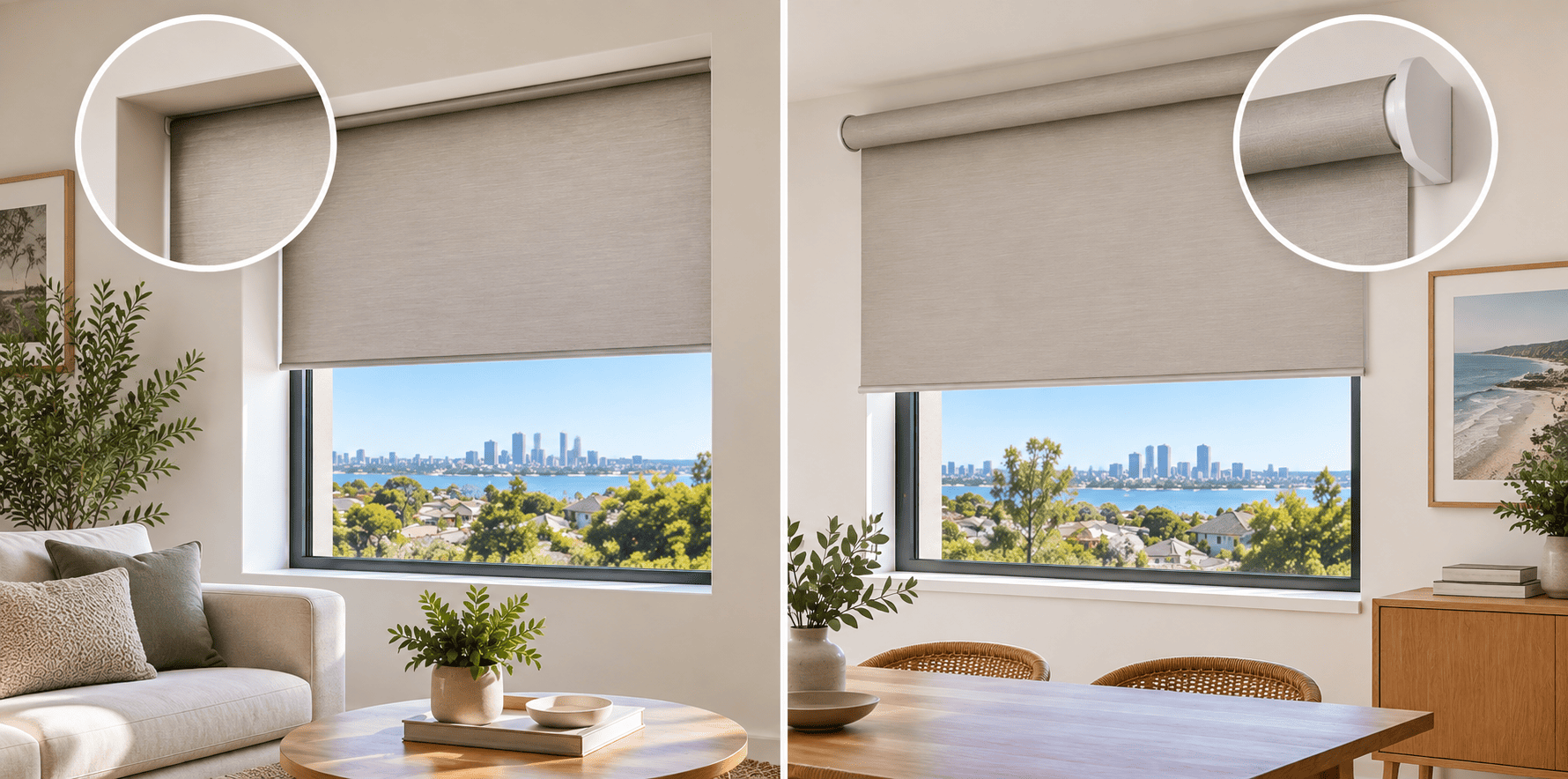
The difference is simpler than the terminology makes it sound. Recess fit means the blind sits inside the window reveal – the recessed space between the front of the wall and the glass. Face fit means the blind sits outside that recess, mounted onto the wall or architrave and covering the window frame.
A simple way to picture it: with a recess fit, the blind sits inside the window opening. With a face fit, the blind sits over the opening.
Neither is automatically the right choice. The window itself usually determines which mounting position will work properly, and that is why your consultant will want to assess the window before finalising the blind.
Why does this decision come up before you’ve even chosen a blind style?
Mounting position is generally worked out during the measure, because the physical window determines what can actually be installed. You may already know you want roller blinds, Venetian blinds or plantation shutters, but the question of how they will sit around the window still needs to be answered.
That matters because the mount affects more than appearance. It changes how much of the window is covered, where light can enter around the blind and how the blind interacts with handles, locks, sills and other fittings.
For a homeowner comparing window blinds in Perth, this is one of those small decisions that can have a surprisingly noticeable effect once the blinds are installed.
What changes if you choose recess mount?
A recess fit gives the window a more built-in appearance because the blind sits neatly within the existing opening. It can work particularly well when you want the window frame and surrounding wall to remain visually clean.
There are, however, a few practical checks to make first:
- Reveal depth: There needs to be enough usable space inside the reveal for the chosen blind and its hardware.
- Window handles: A protruding handle can interfere with the blind or prevent it from sitting as intended.
- Internal sills or tiles: These can reduce the usable space and affect how the blind fits.
- Light gaps: Because the blind sits within the opening rather than covering it, small gaps at the sides can allow some light through.
That last point is easy to overlook. If your priority is maximum darkness or privacy, a recess fit may not provide the same level of coverage as a face fit.
What changes if you choose face fit?
A face fit takes the blind beyond the window opening, mounting it to the wall or architrave so it covers more of the window and frame. For roller blinds, different roller blind systems can accommodate both recess-fit and face-fit configurations, depending on the window and hardware requirements. That extra coverage can be useful when light control and privacy are higher priorities. It can also solve practical problems where the reveal is too shallow or an internal window fitting would obstruct the blind.
The trade-off is that you need sufficient wall or architrave space around the window. The blind will also become more visually prominent because it sits over the opening rather than inside it.
Before choosing face fit, check what is around the window – including nearby walls, cabinetry, doors, handles and other fittings. A technically possible installation still needs enough clearance to operate comfortably.
Which one suits your window?
Once you look at the window itself, the decision becomes much easier. Your measure should establish:
- Reveal depth: Is there enough room inside the opening for the blind and its hardware? If you’re considering custom roller blinds Perth homeowners commonly use, the blind’s hardware and fitting method should also be confirmed during the measure.
- Obstructions: Do handles, locks, flyscreens, sills or other fittings interfere with a recess installation?
- Blind type: Roller blinds, Venetian blinds and plantation shutters have different hardware and clearance requirements. If you’re still deciding between roller blinds vs Venetian blinds, it is worth comparing how each operates before finalising the configuration.
- Light control: Do you want the blind sitting neatly inside the opening, or do you need greater coverage around it?
- Available wall space: If considering face fit, is there enough clear space around the window?
This is also where custom window blinds Perth homeowners order can be useful: the mounting decision can be assessed against the actual window rather than relying on a standard size or assumption. If you’re still comparing blind types, our guide to choosing window blinds in Perth covers the wider factors that affect the decision.
What happens if you pick the wrong one after installation?
The problem usually becomes obvious in everyday use rather than on installation day.
A recess fit that does not account for an obstruction can leave a blind catching on a handle or sitting awkwardly. Choosing recess when you expected near-total light coverage can also leave you disappointed by the light gaps around the edges.
Changing the decision later may not be straightforward either. Once a blind has been manufactured to a particular configuration, changing from recess to face fit can require different measurements, hardware or even a replacement blind. This is one reason custom blinds in Perth can be worth considering when precise fitting matters.
That is why the measure matters. It is not simply about recording the width and height of the window; it is an opportunity to identify anything that could affect the finished installation.
Questions to ask before your measure
You do not need to arrive at the consultation already knowing whether you want recess or face fit. Instead, ask your consultant to explain the practical implications for each window.
Useful questions include:
- Is there enough reveal depth for the blind I’m considering?
- Will the handles, locks or flyscreens interfere with a recess fit?
- How much more light coverage would I get with a face fit?
- Will a face-fit blind have enough clearance from nearby walls, doors or furniture?
- Are there any sills, tiles or other fittings that change the usable window space?
- Does the blind style I’ve chosen affect which mounting option is practical?
- If I choose recess, where should I expect light gaps?
- If I change my mind later, would the blind need to be remade?
Getting these answers before the blind is made is far easier than trying to correct the mounting choice afterwards. Once those practical details are settled, you can focus on the more enjoyable decisions — fabric, colour, finish and the overall look you want from your custom blinds in Perth.
FAQs
A recess mount blind is fitted inside the window reveal, so the blind sits within the existing window opening. It gives a clean, built-in appearance but may allow small amounts of light through the gaps around the edges.
A shallow reveal may not provide enough space for the blind and its hardware, depending on the blind style. Your installer should check the available depth, as well as handles, locks, sills and other obstructions, before recommending a recess fit.
Generally, a face-fit blind can provide greater light coverage because it sits over the window opening and covers part of the surrounding frame or wall. A recess fit leaves the blind within the opening, so some light may enter around the sides.
It may be possible in some situations, but it is not always a simple change. The blind may have been manufactured to specific measurements and hardware requirements, so changing the mounting position could require new measurements, different hardware or a replacement blind.
Not necessarily. Window blinds in Perth should be selected according to the window, the desired light control, available wall space and any obstructions. Face fit can make sense when greater coverage is important or the reveal is unsuitable for a recess installation.
Before ordering custom blinds in Perth, check the window reveal depth, handles, locks, flyscreens, internal sills and the space around the window. It is also worth asking how the chosen blind style will affect the available mounting options.
Recess-fit blinds sit inside the window reveal, while face-fit blinds are mounted over the window opening on the wall or architrave. Recess fitting gives a more contained look, while face fitting generally provides greater coverage around the window.
There is no single mounting option that suits every window. Blinds in Perth can be installed as either recess or face fit depending on the window's dimensions, reveal depth, obstructions, blind type and the level of light and privacy control required.